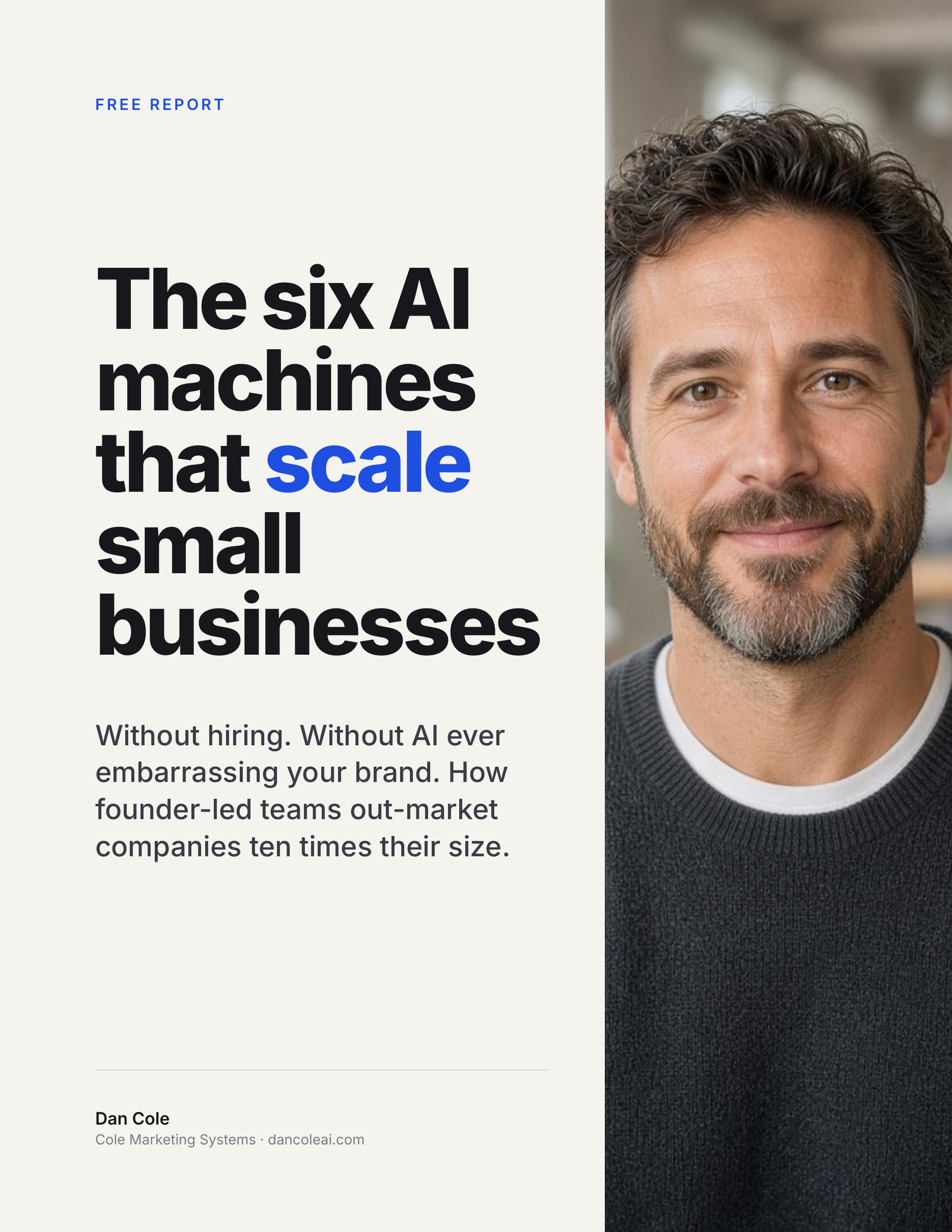
I install AI marketing systems for founder-led brands, publishers, and course businesses that are done getting generic copy out of ChatGPT and done wondering what the AI is saying to their customers. The AI works behind your people. Your people stay in front of your customers.

If anyone on your team has ever pasted "write a welcome email for our brand" into ChatGPT, you know what came back.
It was polite and confident and it said nothing.
So they did what everyone does. Fixed a few lines, sent it anyway, and got the same open rate you always get.
That's the good version.
The bad version is the one where the AI gets in front of a customer. A chatbot that promises something you never offered. A product description that makes a claim compliance never approved. A post that goes out under your brand with an opinion you don't hold.
Big companies have a legal department for that. You have a founder, a marketing person, maybe two, and a customer list that knows your name.
Most founders land in one of two places. They let AI touch everything and cross their fingers. Or they tell the team to stop using it and quietly fall behind the competitor who figured it out.
There's a third option.
That one rule is the difference between a team that gets its weekends back and a brand that ends up as a screenshot.
Behind your people means the AI drafts, researches, sorts, and proposes. A human on your side decides, edits, and sends. Every word a customer reads was read by one of your people first.
The way I make that work is a machine with two parts.
An engine that holds your brand's voice, values, proof, and (most important) the list of things you'd never say. Every draft anyone on your team asks for runs through it before it reaches their eyes.
Keeps your ads and content from going stale.
Runs several angles on your offer instead of one.
Walks every new subscriber through your worldview before you ever pitch.
Makes sure the next offer is written and waiting the week a first order ships.
Wakes up the cold half of your list.
Keeps a record of what worked so nobody starts from scratch again, even after your marketer moves on.
Same voice powering every word, no matter who on the team asked for it. That's how a small team out-markets a big one.
I've spent six years building marketing systems for founder-led businesses, and the last three doing it almost entirely with AI behind the wheel and a human in the driver's seat.
Over 70-plus engagements, the systems I've built have produced more than $14 million in tracked client revenue. Not launches I was near. Revenue that ran through pages, sequences, and offers I built, measured in the clients' own dashboards.
I keep a deliberately small roster. A handful of retainer clients and two or three build projects at a time. That's on purpose. The engine only works when it's trained on real rewrites from people who know the brand, and I'm in the room while that happens.
I wrote the report on this page because most of the advice out there is either "AI will replace your team" or "AI is a toy." Both are wrong, and both are expensive to believe.
"ChatGPT, Claude, Gemini... who cares? They're all motors. You win with the machine you build around the motor." Dan Cole
"Dan's system took our cold-traffic conversion rate from 2.1% to 3.8% in the first month. It paid for itself in nine days."
"Our launch did $211,000 against a $140,000 goal, and nobody on my team wrote an email from a blank page. We read every one of them. We just didn't have to start from nothing."
"I'm a coach with a team of three, none of them marketers. We'd been sending a newsletter 'when we got around to it,' which was never. Dan built the welcome sequence, my ops lead rewrote the parts that didn't sound like us, and now people book calls before we've ever talked to them. Three of our last five clients came in that way."
"What sold me was that Dan wouldn't let the AI anywhere near my students. Everything it drafts comes to my team first. Six months in, we ship in a week what used to take a month, and nobody on my list has noticed anything except that the emails got better."
"We publish four promotional emails a week. Dan's system drafts them, my editor rewrites them, and our open rates went up, not down. Best marketing investment we've made, and I've made a lot of them."
Without Hiring, and Without AI Ever Embarrassing Your Brand
It's about a 15-minute read. No fluff, no upsell inside, and I don't sell your email address.
You'll also get my occasional notes on what's working in AI marketing right now. Unsubscribe any time. One click.
If you'd rather find out which of the six machines would move your numbers first, book a 30-minute AI Marketing Audit Call.
We look at what your team has, what's missing, and whether building the engine makes sense for your business in the next 60 days.
If it does, we talk specifics. If it doesn't, I'll tell you what to do instead. Either way, you leave knowing exactly where AI belongs in your business, and where it doesn't.